
BizTech Law Blog
 Access to capital is one of the most challenging issues facing young companies today. In order to engage in a private placement of securities that is exempt from registration under the federal securities laws, the most popular approach has been an offering under Rule 506, under which most of the requirements that may be imposed under state law are preempted. An offering under Rule 506 permits sales of securities to an unlimited number of accredited investors, and up to 35 non-accredited investors. As described in greater detail below, accredited investors are people who meet minimum wealth or income standards, or institutional investors.
 Ryan Hart is the former starting quarterback for Rutgers University. In addition to setting a number of school records and leading his team to its first bowl appearance since 1978, Hart has added a victory in the courtroom against Electronic Arts ("EA") to his list of accomplishments. In their NCAA Football series, EA Sports provides users with a realistic gameplay experience. Part of this realistic experience is characters that resemble real-life players. So when a player chooses Rutgers, the quarterback is number 13, is 6'2", weighs 197 pounds, and appears wearing a visor and an armband on his left wrist—the resemblance to Ryan Hart is nearly exact. In October of 2009, Hart filed suit against EA Sports for violating his right of publicity by using his appearance in the game.
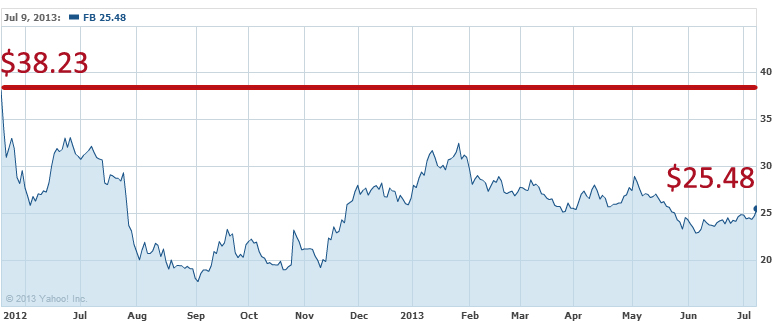
Technology IPOs used to be the norm in the IPO cycle, and when Facebook announced an IPO many investors could not contain the excitement. But less than expected stock results have caused investors to file suit against Facebook and the underwriters of the IPO.
Source: Chart image from Yahoo! Finance
Facebook, along with Morgan Stanley, JP Morgan Chase, and Goldman Sachs, are seeking the dismissal of claims made by investors in connection to the company's IPO. The claims allege misrepresentations by Facebook and its underwriting banks that violated the Securities Act of 1933 and the Exchange Act of 1934. Essentially, the investors claim that Facebook disclosed certain information to the underwriting banks that it did not disclose to investors.
 Among the many recent Supreme Court decisions, one decision regarding patents and self-replicating technology has a huge effect on farmers and the agricultural industry.
Monsanto is an agriculture company headquartered in St. Louis, Missouri. Specifically, Monsanto genetically engineers seeds to yield herbicide-resistant plants that produce higher yields for farmers. One of its more popular products is its "Roundup-Ready" line of soybeans, which has been planted in over 50 million acres to date. The seed is attractive to farmers because it is herbicide-resistant.
 Yes, the FTC can shut down your app. But you could also face stiff penalties for lack of compliance.
COPPA is the Children's Online Privacy Protection Act. The FTC has recently revised the rules regarding collecting personal information from children, and has set a date of July 1, 2013 as the deadline for compliance with the latest revised rule. The revision focuses on applications that collect personal information about children, such as photos, videos, and audio files containing the child's voice.
 Patent-trolling is a growing nuisance for business owners, particularly start-ups. Patent trolls will buy numerous patents – or buy struggling businesses just for the patents – for the sole use of threatening infringement claims on businesses. Most of the time, the threats are unfounded and rarely state which patents are being violated or how the target's use of that patent amounts to infringement.
Vermont has passed a new law that targets these patent trolls and allows their targets to pursue lawsuits against them. The law allows for a cause of action against "bad faith assertions of patent infringements," but does not define what this phrase means. Instead, it provides the courts a list of characteristics to consider when determining if an infringement assertion was made in bad faith.
 In 2007, Newegg adopted a strategy to deal with patent trolls: Never settle – ever.
One of the first times it applied this new strategy was against Soverain Software. While Soverain's website appears legitimate, it has never made a sale. Instead, it targets large, online retailers that use shopping cart checkout technology. Soverain claimed that through two patents, numbers 5,715,314 and 5,909,492, it owned the "shopping carts" present in nearly every online retailer's website.
 Lansing-based XG Sciences, Inc. has launched a new generation of anode materials for lithium-ion batteries with four times the capacity of conventional anodes. The new anode material is produced through proprietary manufacturing processes and uses XG’s xGnP® grapheme nanoplatelets to stabilize silicon particles in a nano-engineered composite structure. The material displays dramatically improved charge storage capacity with good cycle life and high efficiencies.
This is great news for applications like smartphones, tablet computers, and other products that use rechargeable lithium-ion batteries. XG is working with battery makers to translate this exciting new technology into batteries with longer run-time, faster charging capabilities, and smaller sizes.
Click here for more information about this exciting development.
 As noted in a prior blog article, investment crowdfunding is awaiting SEC regulations. However, “reward” and “experience” based crowdfunding via websites such as Kickstarter have seen success.
On March 13, 2013, Rob Thomas, the creator of Veronica Mars, launched a Kickstarter project to fund the making of a Veronica Mars movie. Veronica Mars was previously a television show on UPN that aired from 2004 to 2007. It took only 11 hours for the project to meet its funding goal of $2 million dollars. The initial fundraising goal was to raise $2 million in 30 days.
The White House has declared that the results of government funded research, with certain exceptions for classified data, will be available to the public for free within in a year. Such results include peer-reviewed publications and digital data.
