
BizTech Law Blog

It is that time of year again when campuses across the country come alive as we enter into another college football season. Few traditions are as ingrained in college football culture as the pregame tailgate. Friends gather around grills, fans celebrate their teams, and parking lots transform into all-day events. While most tailgates end with a walk to the stadium, we also see many game days cut short when law enforcement arrives.
Alcohol is often at the center of tailgate-related offenses. Drunk driving (known as operating while intoxicated in Michigan), public intoxication, and ...

Whether you are an influencer with a million followers or a thousand, if you endorse brands or products, you are required to abide by the Guidelines set forth by the Federal Trade Commission (“FTC”) when making recommendations to your viewership. The FTC’s Guides Concerning the Use of Endorsements and Testimonials in Advertising (“Guidelines”) addresses how advertisers and endorsers can remain legally compliant when promoting businesses, goods, or services (collectively, “Products”) without making “deceptive ads”. Failing to abide by the FTC’s ...
 Influencer marketing on social media is a very big business. Here’s how it works: brands team up with individuals with large and engaged followings on social media platforms such as YouTube, Facebook and Instagram (i.e., “influencers”), and pay them to promote their products.
 Businesses are understandably concerned about negative reviews posted on popular websites such as Yelp, Facebook, and TripAdvisor.
 Last month, the U.S. Supreme Court ruled that the federal law that prohibits sending threats over the internet requires some level of intention by the sender. The ruling leaves some issues open but is significant for those who engage in hyperbole online.
 Social media is a great tool for companies to build their brands. Many have moved from nearly invisible to viral superstar status, thanks to a well-timed Tweet, Facebook post or clever YouTube video. But with this power comes risks.
One tried and true marketing tactic - both in social and traditional media - is leveraging the power of endorsements. If others are happily using or consuming a product it must be worthwhile, right? While the law and regulatory framework regarding social media promotion is still evolving, social media endorsement is an area that has recently received additional scrutiny from government regulators.
 Unmanned aircraft systems - drones - are become increasingly popular and less expensive. From drone pilot hobbyists to online retailers, recreational and business use of drone technology is likely to increase over the coming years. The Federal Aviation Administration (FAA) has taken notice.
 The term "competitive intelligence" is the process of legally gathering information about one's competitors to gain a strategic advantage in the marketplace. Large corporations will have strategic intelligence experts as a part of their marketing department. These experts specialize in discovering promotional activities, sales figures, and other information about the company's competitors. Ideally, strong competitive intelligence enables a company to predict the strategy of a competitor and adapt with a strategy of its own that will result in an advantage in the marketplace.
The good news is that small and medium-sized businesses are not usually the targets of professional competitive intelligence experts. However, a business owner would be wise to protect itself from amateur intelligence gathering by its competitors. Competitive intelligence gathering begins by identifying the strategy of your own business and how your competitor's strategy will interfere. Then the intelligence gathering begins.
Chris Holman interviews attorney John Mashni on the Michigan Business Network discussing social media policies.
 I know you've probably heard this before, but it's worth repeating: be careful what you post on social media.
It may be used against you. For one NFL player, it cost $5 million.
New Orleans Saints football player Jimmy Graham was recently in a contract dispute with the Saints over whether he should be designated as a "Tight End" or a "Wide Receiver." While the distinction may seem trivial, it had huge repercussions in terms of salary.
 The gossip website, thedirty.com, is immune from liability for online posts about an ex-Bengals Cheerleader’s sexual promiscuity and acquiring a sexually transmitted disease. In a closely followed decision from a case that has generated considerable media coverage because of its potential to chill online speech and hold internet websites such as Facebook, Twitter and newspaper sites liable, which allow third party users to post content, was reversed. The U.S. Court of Appeals for the Sixth Circuit recently overturned a jury verdict of $338,000 against gossip website thedirty.com and its owner Nik Richie. Sarah Jones v. Dirty World Entertainment Recordings LLC arose after Sarah Jones, a former Cincinnati Bengals cheerleader and teacher who was subsequently convicted of having sex with a high school student, sued the website after it posted unflattering information about her sexual promiscuity with football team players, she demanded the posts be removed, and the website refused. She filed state law tort claims for defamation and privacy torts and won at trial. The defendants appealed.
 Did you know that the YouTube video you just posted may be used in court to determine your character? In a Delaware case, Gallaway v. State, a video of a man using mouthwash as a decongestant may have been the difference for the jury, which found him guilty of murdering his daughter. The father claimed he was performing stretching exercises with his daughter when she slipped and fell on the floor. A few days after the fall, she died from suspected non-accidental trauma.
Twitter announced, via a tweet, that it is going public. This could be the biggest tech IPO since Facebook in May 2012.
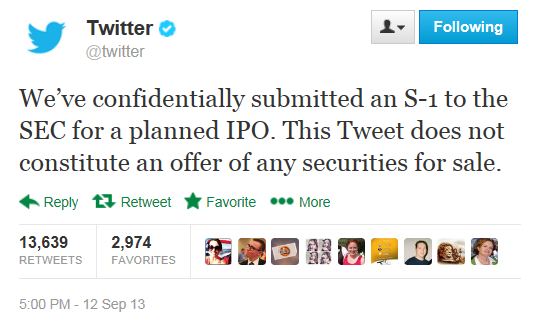
Twitter is using a provision of the JOBS Act that allows a company that has revenue less than $1 billion to file an IPO in without having to disclose its financials to the public.
Here's a link to what we know so far about the Twitter IPO.
Subscribe to our technology blog and we will keep you updated as this news breaks. Please contact John W. Mashni by email at jmashni@fosterswift.com or by phone at 517.371.8257 with any questions.
Technology IPOs used to be the norm in the IPO cycle, and when Facebook announced an IPO many investors could not contain the excitement. But less than expected stock results have caused investors to file suit against Facebook and the underwriters of the IPO.
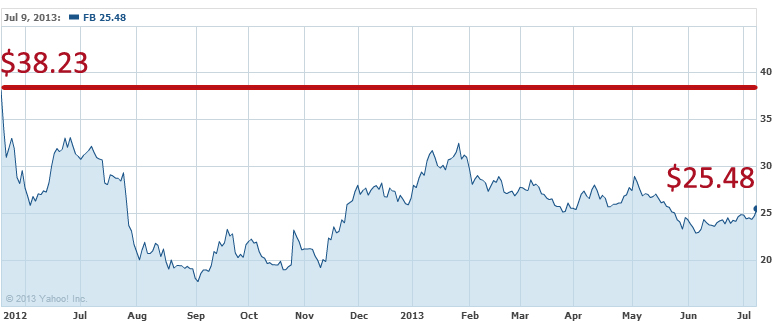
Source: Chart image from Yahoo! Finance
Facebook, along with Morgan Stanley, JP Morgan Chase, and Goldman Sachs, are seeking the dismissal of claims made by investors in connection to the company's IPO. The claims allege misrepresentations by Facebook and its underwriting banks that violated the Securities Act of 1933 and the Exchange Act of 1934. Essentially, the investors claim that Facebook disclosed certain information to the underwriting banks that it did not disclose to investors.
 Yes, the FTC can shut down your app. But you could also face stiff penalties for lack of compliance.
COPPA is the Children's Online Privacy Protection Act. The FTC has recently revised the rules regarding collecting personal information from children, and has set a date of July 1, 2013 as the deadline for compliance with the latest revised rule. The revision focuses on applications that collect personal information about children, such as photos, videos, and audio files containing the child's voice.
 It is undeniable that the internet is here to stay, playing an increasingly critical role in our ability to obtain and disseminate information. No matter the application – business, entertainment, politics, etc. – the internet has become a staple of everyday life. For many individuals with disabilities, however, navigating the internet can be a less than satisfying endeavor.
 Facebook has reached a settlement with the Federal Trade Commission regarding charges that it violated users' privacy rights.
Why Facebook was under investigation?
In December 2009, privacy advocates filed a complaint with the FTC following certain changes to Facebook privacy policies. Specifically, the FTC complaint alleged that Facebook made aspects of its users' profiles - such as name, picture, and friends list - public by default and without user consent. The FTC stated that such actions violated user expectations of privacy and threatened the "health and safety" of users by exposing "potentially sensitive affiliations" such as political views and sexual orientation.
The FTC complaint also alleged other situations where Facebook "made promises that it did not keep," such as promising that it would not share information with advertisers or retain data that it promised users was deleted.
In West Virginia v. Dellinger, the West Virginia Supreme Court held that a juror's failure to disclose her MySpace "friendship" with the criminal defendant violated the defendant's constitutional right to a fair and impartial jury. In Dellinger, the defendant, a sheriff, was convicted of multiple felonies relating to the fraudulent administration of a grant program. The juror in question was a MySpace "friend" of the defendant and posted a message on the defendant's MySpace page one week before trial. During voir dire, the juror was asked whether she had any social relationship with the defendant. However, the juror did not acknowledge her MySpace "friendship," and the defendant did not realize that the juror and his MySpace "friend" were one in the same until after the trial.
If you own or are operating a video or file sharing website that utilizes another's content (read another's copyrights) the following case presents you with a valid defense. If you are the user whose copyright has been infringed, this law is worth knowing before proceeding with costly litigation.
Veoh Networks - a video hosting website - sought protection under the Digital Millennium Copyright Act's safe harbor provision against a user's infringement claims. The user claimed Veoh (1) knew of and failed to remove infringing videos uploaded by other users; (2) had the ability to control infringing activity on its system; and (3) that its infringer policy was inadequate.
In what has become an increasing trend, a plaintiff in a personal injury suit has been ordered to produce otherwise "private" postings on her Facebook and MySpace social networking profiles. In Romano v. Steelcase, Inc., a New York Supreme Court case, the plaintiff alleged that she suffered serious and permanent injuries after falling off a defect desk chair manufactured by Steelcase. The plaintiff further claimed that, as a result of these injuries, she was almost entirely bed-ridden.
