
BizTech Law Blog

Whether you are an influencer with a million followers or a thousand, if you endorse brands or products, you are required to abide by the Guidelines set forth by the Federal Trade Commission (“FTC”) when making recommendations to your viewership. The FTC’s Guides Concerning the Use of Endorsements and Testimonials in Advertising (“Guidelines”) addresses how advertisers and endorsers can remain legally compliant when promoting businesses, goods, or services (collectively, “Products”) without making “deceptive ads”. Failing to abide by the FTC’s Guidelines can result in you facing significant civil penalties.
We know this sounds scary and intense – federal requirements and fines, just for posting a TikTok video or an Instagram story endorsing a Product you enjoyed? However, the truth is, compliance with the FTC’s guidelines is not that scary, and you can ensure you’re following the rules within your social media content without much hassle. In this blog post, we break down the basic requirements of the FTC Guidelines that all influencers must follow when promoting any consumer Product.
1. Assess Your Personal Experience with the Product.
We understand most influencers are honest in their Product reviews. However, there are times when a brand partnership appears irresistible. Be sure to assess your personal experience with a Product before agreeing to a brand deal opportunity.
If you are approached by a business to endorse a Product, but you personally hated it, you cannot tell your followers you liked the Product. You also cannot talk about an experience with a Product that you yourself haven’t tried. Moreover, the FTC cautions against influencers making claims about Products that would require proof you cannot guarantee.
For example, if you are asked by a brand to review a skincare Product, you cannot assert in your content that the Product cures or treats a medical condition. You should limit your endorsement to your actual experience with the Product and brand. Often, brands provide influencers with research statistics the business itself conducted to use in a promotional post. Please note that you are required to conduct your own diligence to ensure the statistic is a valid figure before sharing that figure with your audience. And if a business requests you promote a Product you did not enjoy, you are both legally obligated to decline that opportunity per the FTC’s Guidelines and morally required to stay honest with your followers to avoid creating a deceptive ad.
2. Determine if a “Material Connection” Exists Between You and the Product.
The FTC Guidelines require disclosure for any Product which the promoter has a “material connection” to. This means that if you have a personal, familial, financial, or employment relationship with the brand whose Product you are promoting, you are required to disclose this relationship to your followers. The FTC Guidelines only apply to Products that you are being paid to promote or have received from a business for free or at a discounted rate. Products that you buy on your own from a brand that you have no material connection with do not require disclosure.
You are not obligated to clarify or declare that you do not have any affiliation with a brand when sharing information about a Product with your followers. However, be mindful of the ways you may be endorsing Products without realizing it. Keep in mind that tags, likes, pins, and similar positive feedback on social media can be seen as promoting a Product.
3. Obviously Disclose Your Material Connection in Your Promotional Material.
Your promotional post must include an obvious disclosure that you are confident your followers will see and understand. The FTC recommends disclosures be: (a) prominent and hard to miss; (b) made at the beginning of posts or videos when engagement is the highest; (c) located at the top of your caption (e.g., not where followers will have to click the “…more” icon to read it); (d) within the photo or video itself, as opposed to just in the description uploaded with such content; (e) in the same language as the endorsement itself; and (f) repeated, if necessary, such as if your endorsement is delivered via a live stream or long-form video. (f) repeated, if necessary, such as if your endorsement is delivered via a live stream or long-form video.
Below is a fictional example of what is and what is not an FTC abiding disclosure in the context of an Instagram photo story. The image on the left is FTC compliant while the image on the right is an FTC violation:
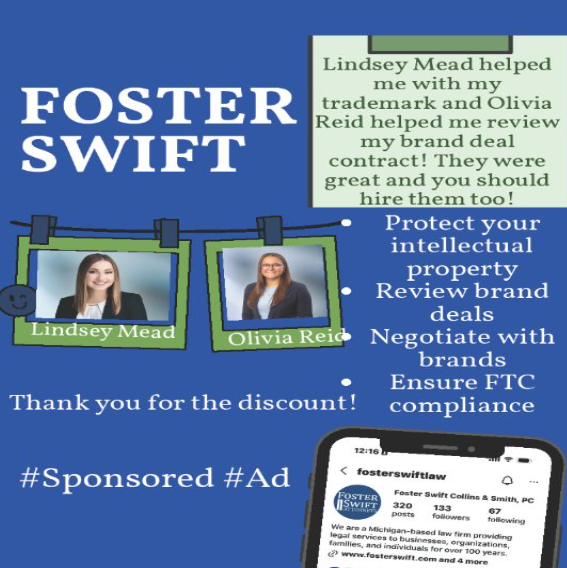

The FTC Guidelines also caution against the use of vague terms or abbreviations like “spon” or “collab” to connect your content to a brand deal. Simply thanking the business who offered the promotion or identifying yourself as an influencer is likely not conspicuous enough, either.
4. Understand the Consequences if You Do Not Abide by the FTC Guidelines.
The FTC has determined that certain acts or practices that harm United States-based consumers and do not abide by the Guidelines may be classified as deceptive or unfair. Thus, content that doesn’t comply with the Guidelines would violate the Federal Trade Commission Act of 1914 (the “Act”).
If your promotional post is found to violate the Act, you may receive a “Notice of Penalty Offense” from the FTC (“Notice”). A Notice would outline the unfair or deceptive practices you’ve participated in that violated the Act and notify you of the civil penalty (per violation) you have incurred. Currently, you can face civil penalties of up to $50,120.00 per violation of the FTC Act, though penalty maximums are adjusted for inflation every January.
Please note that you are not immune from FTC Guidelines if you make endorsement content abroad. If it is “reasonably foreseeable” that United States-based consumers will be impacted by your post, the FTC Guidelines apply. Foreign laws related to deceptive ads and endorsement regulations may also apply.
Since you alone are responsible for your endorsements, be sure you take these obligations into your own hands. Do not assume a social media platform’s disclosure tool is sufficient on its own to meet the requirements under the FTC Guidelines. For additional information on Notices and the FTC’s Guidelines, please review the following helpful resources attached here:
- Notice of Penalty Offenses Concerning Deceptive or Unfair Conduct around Endorsements and Testimonials;
- Notices of Penalty Offenses | Federal Trade Commission; and
- Disclosures 101 for Social Media Influencers | Federal Trade Commission.
Navigating the FTC Act and Guidelines are a difficult task. If you need assistance ensuring your endorsement posts are FTC compliant, or with reviewing related brand deal contracts, negotiating with brands, or trademarking your brand as an up-and-coming influencer, we are here to help! You can easily contact us by clicking on our information below:
- Lindsey Mead… 517.371.8326…lmead@fosterswift.com
- Olivia Reid… 517.371.8371…oreid@fosterswift.com
 Associate
Lindsey Mead is an associate with the firm's Business & Tax practice group in Lansing. Lindsey focuses on business law, business contracts, intellectual property, and legal matters associated with business' use of artificial ...
 Associate
Olivia Reid is an associate in Foster Swift's Business & Tax Practice Group in Lansing, Michigan. She helps business owners, nonprofit organizations, and individuals navigate complex legal and tax matters, with a particular focus ...
