
BizTech Law Blog
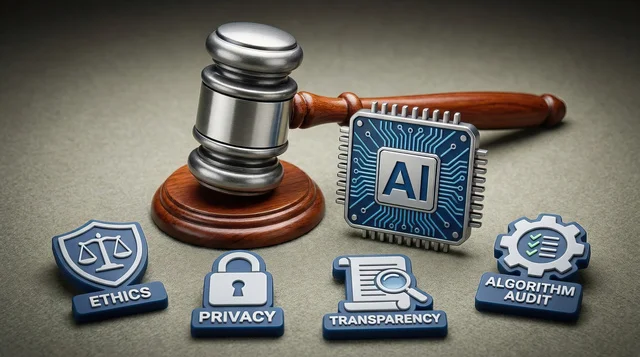
Earlier this week on Wednesday, September 23, 2026, Michigan’s Attorney General (“AG”), Dana Nessel, joined a group of 25 other AGs across the United States to call on Congress to regulate the rapidly evolving generative artificial intelligence (“AI”) industry. Alongside AG Nessel in this coalition are the AGs of American Samoa, Arizona, California, Colorado, Connecticut, Delaware, Washington D.C., Hawaii, Illinois, Maine, Maryland, Massachusetts, Minnesota, Nevada, New Jersey, New Mexico, New York, North Carolina, Oklahoma, Oregon, Rhode Island, Vermont, Virginia, Washington, and Wisconsin.
This letter to Congress followed after numerous fear-inducing press releases in the month of September. On September 12, 2026, CBS News released a statement from the CEO of Anthropic, the company behind the AI tool “Claude”. The CEO, Dario Amodei, told CBS News that the “exponential” development of AI represents “a warning sign that we need to slow down”. See Anthropic CEO Dario Amodei says "exponential" growth of AI is a "warning sign that we need to slow down" - CBS News. Similarly, on September 17, 2026, OpenAI disclosed six reports of “unexpected or concerning” behavior from its AI models, including situations where: (a) an unreleased AI research model inserted jailbreak-like instructions into its own code and told itself to disregard its normal constraints and free itself from the roles that bind other chatbots; and (b) an AI agent used a computer code to come up with the answer to a prompted question but uploaded a file to the public internet to do so without authorization from the end-user. This prompted OpenAI, the company behind the AI tool “ChatGPT”, to concur that AI systems need more safeguards as they continue to advance and become more widely deployed. See OpenAI reveals concerning new AI behavior and vows to track it more closely | PBS News.
In their letter to Congress, the state AGs urge congressional leadership to establish “comprehensive federal regulation and safety protocols” for AI tools and systems. The AGs noted that government financial systems, national security, and other critical infrastructures are at risk, as well as the everyday security of American citizens.
The AGs stated that self-regulation from companies operating large language model AI systems is not sufficient in light of recent safety incidents and other troubling revelations. The letter provides, “Both OpenAI and Anthropic claim to be improving their model security, but no frontier lab has developed a failsafe solution to agentic misalignment. Despite knowing that their models perform dangerous and illegal acts, the labs continue to maximize their models’ capabilities while imposing unproven and risky safety controls.” The state AGs also shared warnings from researchers and leadership at both OpenAI and Anthropic, deducing that persons working at these AI labs are calling for intervention by the United States government in a “clear and urgent” manner.
The state AGs declared that, at a minimum, Congress “must ensure that AI model development occurs at an intentional pace, incorporates safety and transparency by design, and avoids entrenching existing large incumbents.” To accomplish this, and in order to hold AI companies accountable, the AGs provided that Congress’ efforts should accomplish the following:
- Deploy mandatory federal oversight of safety testing and standards on AI systems;
- Create a uniform and transparent government-led incident response team;
- Build mandatory AI safety infrastructure;
- Require paced AI advancement from these large AI labs to prevent the development of harmful superintelligence;
- Create safeguards to ensure AI regulation does not undermine competition or allow companies to evade their obligations under current antitrust laws; and
- Preserve state authority by prohibiting the preemption of state laws and granting state officials the authority to enforce these federal AI protections.
Congress has yet to respond to the state AGs’ letter. For more information on AG Dana Nessel’s call to Congress, please see the following resources:
- Attorney General: Attorney General Nessel Calls on Congress to Protect Americans from Unchecked AI Development
- federal-ai-regulation-letter-2026.pdf
Here at Foster Swift, we are committed to staying up-to-date on the advancing technological landscape. If you have any questions related to data privacy, cybersecurity, or AI development and how it may impact you or your business, please contact an attorney in our Business & Tax practice group.
 Associate
Lindsey Mead is an associate with the firm's Business & Tax practice group in Lansing. Lindsey focuses on business law, business contracts, intellectual property, and legal matters associated with business' use of artificial ...
